In brief
What can I do when pressure at work feels unbearable?
Treat “unbearable” as a signal that the present arrangement needs attention, not as proof that you are failing. Examine the demands, resources, authority and recovery available to you; create enough room for your thinking to widen; and choose one next action rather than trying to solve your whole career at once.
Maybe everything still looks fine on the outside. You attend the meetings, make decisions and people depend on you. But on the inside, it feels unsustainable. The demands are too high. You struggle to meet your own expectations. There is too much work, too little time, and you aren't sure you are really appreciated.
In this situation, many people turn up the pressure on themselves. You might wonder if you've lost your edge, just aren't smart enough or need more education. But unbearable pressure rarely points to a performance issue.
“Unbearable” is a signal, not a verdict
You might be exhausted, frightened of failure, trapped by financial obligations, angry about impossible expectations or morally distressed. You might be dealing with harassment or discrimination. Anxiety, depression, trauma, a medical problem or burden at home may also be contributing to your sense of overwhelm.
This doesn't mean you're a failure, that the situation is impossible or that there is no hope. Instead, it is a signal that something needs attention. The solution might be dramatic - like a leave of absence or a new job. But often, a small shift in how you see, understand and respond can make a big difference.
Facing information overload, it's easy to lose track of what your body is telling you and how certain thoughts become charged with emotion.
What are the signs of job burnout?
The World Health Organization describes burnout as arising from chronic workplace stress that has not been successfully managed. They identify three dimensions: exhaustion, cynicism about the job, and reduced professional efficacy.
A person who doesn't fit that description can also be deeply affected by work stress. Signs may include:
- not feeling restored on days off;
- disrupted sleep and rumination;
- small decisions feel overwhelming;
- increasing feelings of detachment, irritation or contempt;
- avoiding simple messages and tasks;
- loss of interest in friends and hobbies;
- increasing use of alcohol, cannabis, food, or other behaviours to calm anxious thoughts.
Pressure is more than workload
Volume matters, but it is rarely the entire story. The Canadian Centre for Occupational Health and Safety describes workplace stress as what happens when job demands conflict with the control a worker has to meet them. By contrast, support, role clarity, recognition, fairness, workload management, psychological safety and work-life balance reduce a worker's stress. A systematic review of workplace reorganization suggested that increasing employee empowerment may benefit health, while reductions in self-determination may have adverse effects.
Two people can carry the same number of tasks and experience them very differently. A demanding role with meaningful authority, trusted colleagues, time to recover and a good fit may be sustainable. A smaller workload paired with poor fit, ambiguity, constant interruption, low control, interpersonal threat or values conflict may not be.
A more useful question than “What is wrong with me?” might be “How could I approach this situation in a healthy and effective way?”
Pressure narrows the field of view
Looking back across more than twenty years leading global software teams, I can now reflect upon many situations that felt more fixed than they actually were. Under pressure, my choices seemed to collapse into stark alternatives: absorb the problem myself or let people down; deliver what had been promised or admit failure; tolerate the situation or leave.
Sometimes the constraints were real. A deadline did not go away because I complained, and an organization did not become healthier because I changed my attitude. But my view of the situation was often much more rigid than the situation warranted. I tended to treat commitments as immovable, asking for help as incompetence, changing course as failure and carrying relentless pressure as simply what the job required.
There were often more possible responses than I could see in the moment. Conversations I could have started, trade-offs I could have named, people I could have invited into a decision or smaller experiments I could have tried. Sometimes I held back because I thought it was “not my job,” expected someone else to act or did not trust others to hear my position.
Choosing those options would neither have been easy nor guaranteed to work. But pressure had narrowed my field of view such that I could not even see the possibility.
Under high stress, the story that there is only one possible move can feel like a fact.
Why can't you think clearly under stress?
The Yerkes-Dodson curve offers one way to picture the relationship between pressure and performance: some activation may support a task, while too much can make demanding work harder.
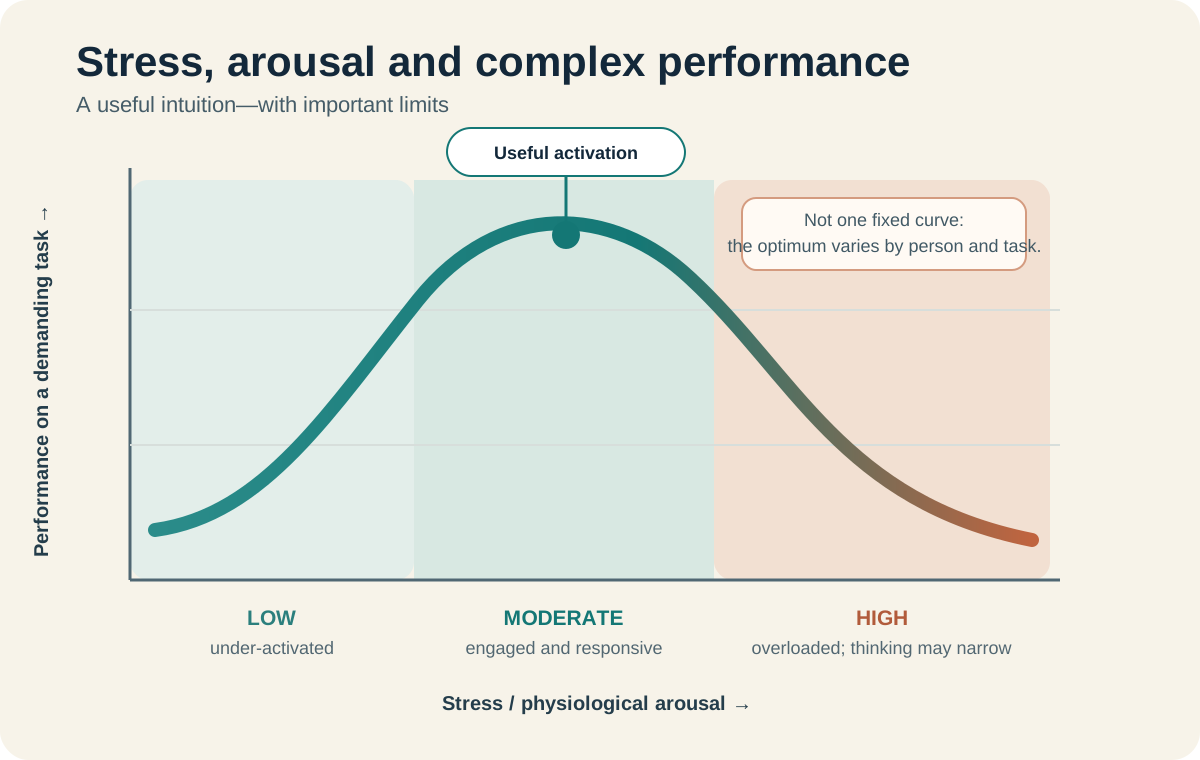
This curve is a useful approximation but not a universal law. The relationship varies with the person, task and context.
This idea explains why a deadline can help people focus, but when stress becomes too intense productivity falls. It becomes harder to hold information in mind, compare options, and see the wider context.
A review of the neuroscience of stress describes how chemical changes during acute, uncontrollable stress can weaken prefrontal functioning while strengthening faster, more habitual or threat-focused responses. Stress is not a single switch in the brain. The amygdala, hypothalamus, brainstem, autonomic nervous system and hormonal pathways interact to prepare the body for action.
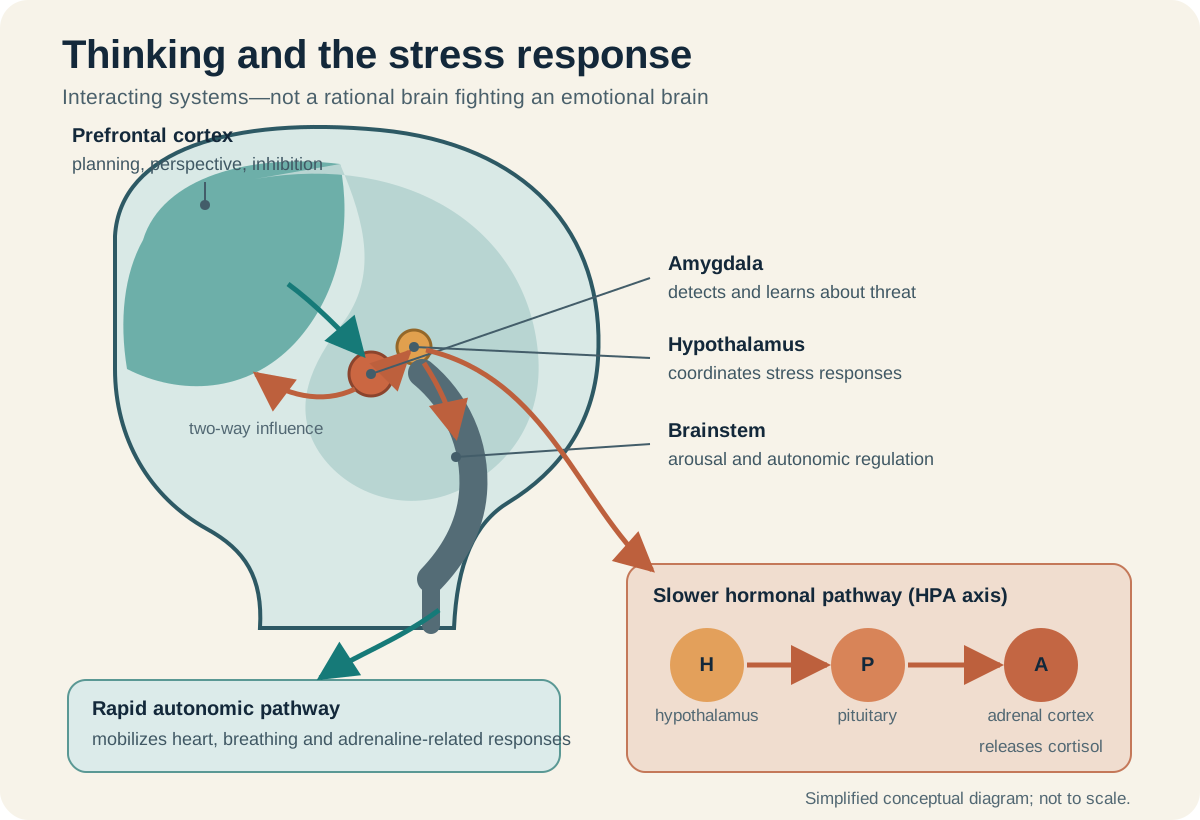
A simplified conceptual map of interacting stress-response pathways. The regions and pathways are not drawn to anatomical scale.
Imagine a tiger jumping out from behind a rock. Do you calculate the velocity and distance to see how much time you have, or do you run? The amygdala fires and adrenaline courses through you, allowing you to run faster than ever before.
But the interesting thing is that there is a two way relationship between the prefrontal cortex (PFC) and the amygdala. Suppose the next day you see a shadow in the grass. Your PFC interprets that input to mean the tiger is back, which arouses the amygdala and gives you that shot of adrenaline again.
The stories we tell ourselves can decrease our creativity and ability to perform complex tasks
The PFC can also down-regulate the amygdala. Suppose you've seen the shadow five days in a row, and the tiger never appeared. Now your amygdala might fire, but the PFC says "you've seen that five times before - it's probably nothing". The amygdala calms down and you regain your thinking power.
Rapid responses are useful when immediate action matters. Workplace problems usually require something different: sustained attention, imagination, perspective, social judgment and the ability to tolerate uncertainty. Those capacities can become harder to access when the situation feels threatening and the stress response remains activated.
First, create enough room to think
When you are acutely overloaded it's helpful to focus on the short-term.
Stabilize the next 24 to 48 hours
Eat something, protect sleep where you can, step away from the screen and tell one trustworthy person what is actually happening. If possible, defer non-urgent commitments or take some time off. Your goal is to restore capacity to make better decisions.
Name the problem
List the pressures you are feeling. Identify the things that truly must happen now, those that can wait, those needing clarification and those that do not belong to you. List the things you can control, those you can influence and those you can't. See if you can interrupt the feeling that every concern is equally urgent and entirely yours.
Make one concrete request
“I am overwhelmed” is honest but may leave a manager unsure what to do. When it is safe, make the trade-off visible: “With the present staffing, we can deliver A by Friday or A and B by next Wednesday. Which outcome should I plan for?” Or: “I am receiving competing priorities from two teams. I need one person to make the final call.”
Do not confuse endurance with effectiveness
In leadership roles, identity and responsibility easily fuse. You may believe that absorbing pressure is how you protect the team, that indispensable means valuable, or that leaving would expose everyone else to the problem. I spent two decades leading software teams and know how compelling that logic can feel. But those are exactly the thoughts that take creativity off the table and eliminate the best options.
Stepping back, renegotiating a role, taking leave or deciding to leave an organization is not necessarily failure. Nor is it courageous to stay in an environment that doesn't work for you out of loyalty. Once you have enough cognitive room to consider the decision, ask which choice best reflects your values, your obligations and your health.
When psychotherapy may help
Therapy cannot make an exploitative workplace fair or change a difficult co-worker or boss. It can help you notice the beliefs and emotional patterns that keep you trapped, regulate enough to think clearly, grieve changes in identity, communicate limits and make decisions that are less governed by panic or shame.
If the pressure has become a crisis
This article is general information, not crisis advice. If you are in immediate danger, call 911. If you are thinking about suicide, call or text 9-8-8 in Canada, available 24 hours a day.
Sources and further reading
- World Health Organization: Burn-out as an occupational phenomenon
- Canadian Centre for Occupational Health and Safety: Workplace Stress - General
- Canadian Centre for Occupational Health and Safety: Psychosocial risk factors in the workplace
- Egan and colleagues (2007): The psychosocial and health effects of workplace reorganisation: systematic review
- Yerkes and Dodson (1908): The relation of strength of stimulus to rapidity of habit-formation
- Teigen (1994): Yerkes-Dodson: A law for all seasons
- Arnsten (2009): Stress signalling pathways that impair prefrontal cortex structure and function